Health calculator
Weight loss percentage calculator
Type your starting weight and your current weight. Peptade divides the difference by your starting weight to show the percentage you've lost — the measure researchers commonly use to describe weight-change outcomes.
Weight loss percentage calculator
Weight lost
—
Difference
—
An estimate from a standard published formula, for general self-tracking only — not medical or dietary advice. Your needs may differ; ask a qualified professional.
Published by Peptade · Health calculator · Updated September 2026
Pounds or kilograms lost tell you less than you'd think once you compare across different starting points — five kilograms means something different on a 60-kilogram frame than on a 150-kilogram one. Percentage of starting body weight is the measure researchers commonly report instead, because it's comparable across people.
This tool is one subtraction and one division: your starting weight minus your current weight, divided by your starting weight. Nothing more goes into the number.
The formula
Percentage lost equals your starting weight minus your current weight, divided by your starting weight, shown as a percentage. If your current weight is higher than when you started, the tool reports the change as a gain instead.
Why researchers use this measure
NIH's National Institute of Diabetes and Digestive and Kidney Diseases points to five to seven percent of starting body weight as a range where several health measures — blood pressure and blood sugar among them — have shown measurable improvement in research. That's a finding about groups studied, not a promise about your own results, and it's one reason the percentage, not the raw number, is the figure worth watching.
Track it, don't recalculate it.
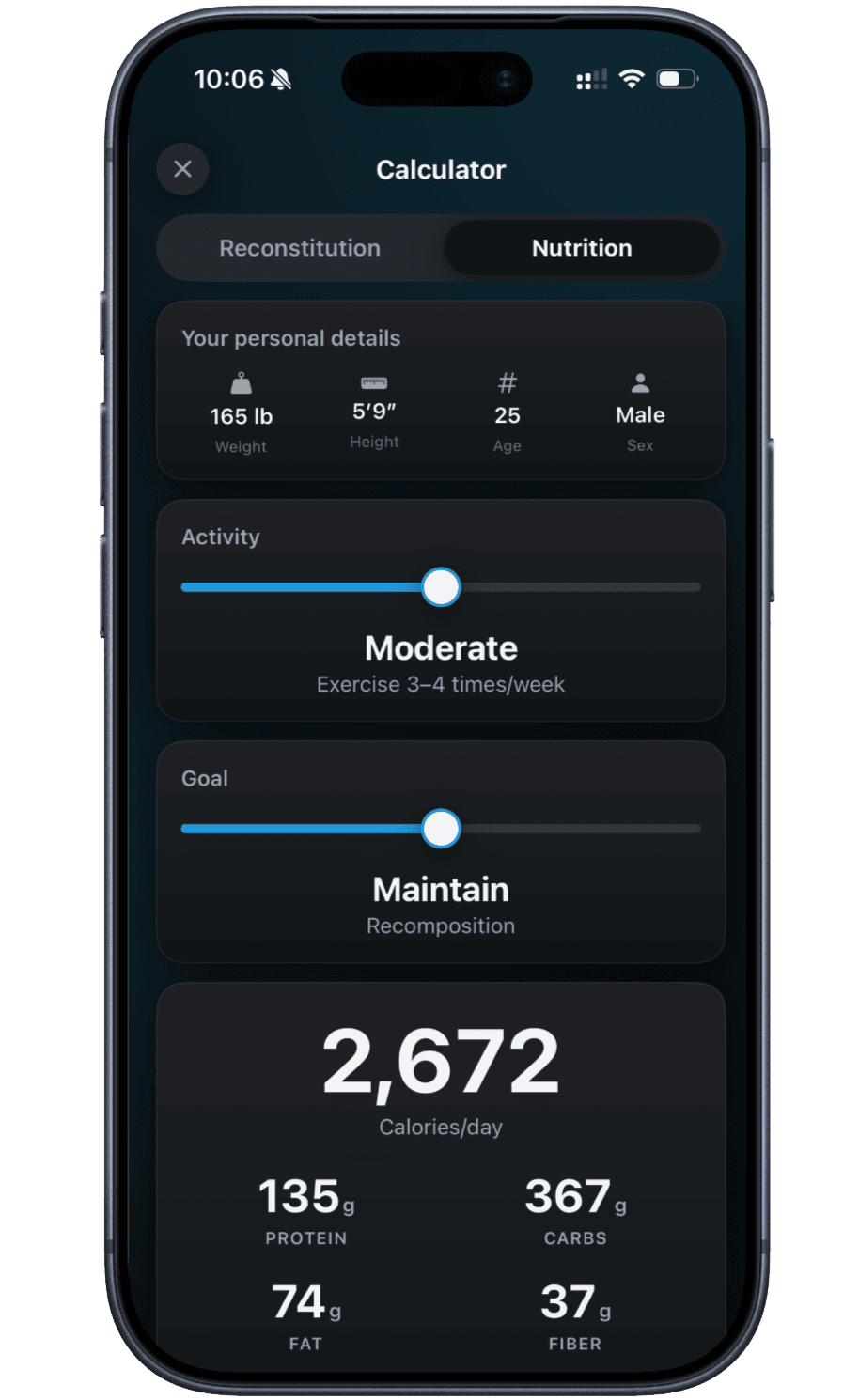
Peptade logs meals, water, weight, sleep and workouts next to your compounds, so the numbers build a trend on their own.
- Saved per compound
- Schedules, cycles and titrations
- Supply that counts down
Frequently asked questions
Because raw amounts aren't comparable across different starting weights, and research on weight-related health measures is generally reported as a percentage of starting body weight rather than an absolute amount.
NIH research has associated five to seven percent of starting body weight with measurable improvements in some health measures, but that's a finding about groups studied, not a prediction for you personally, and it isn't a target this tool sets for you.
No — if your current weight is above your starting weight, the tool labels the result a change (gain) rather than forcing it into a negative loss figure.
More free tools
- Health calculatorGoal weight timeline calculatorEstimate how many weeks a steady weekly rate would take to close the gap between your current weight and your goal weight, at a pace you set.
- Health calculatorBMI calculatorCalculate adult BMI from your height and weight and see where it falls in the CDC's four BMI categories, with CDC's own caveats about what BMI misses.
- Weight trackerWeight Tracker with a Progress ChartLog a daily weigh-in in kg or lb, chart it over the range you pick, and see how far you are from a goal weight you set.
- Health calculatorDaily calorie (TDEE) calculatorEstimate total daily energy expenditure from your age, weight, height and activity level using the Mifflin-St Jeor equation and CDC activity guidance.
Nutrition, hydration, exercise and weight values are approximate and for general self-tracking only — not medical or dietary advice. If you have or suspect an eating disorder, a history of disordered eating, or any condition for which calorie or weight tracking could be harmful, consult a qualified healthcare professional before using these tools. See the Medical Disclaimer.