Medication level
Medication Level, Estimated from Your Doses
See an estimated level curve for a compound, from the half-life you enter and the doses you log.
Published by Peptade · Medication level · Updated September 2026
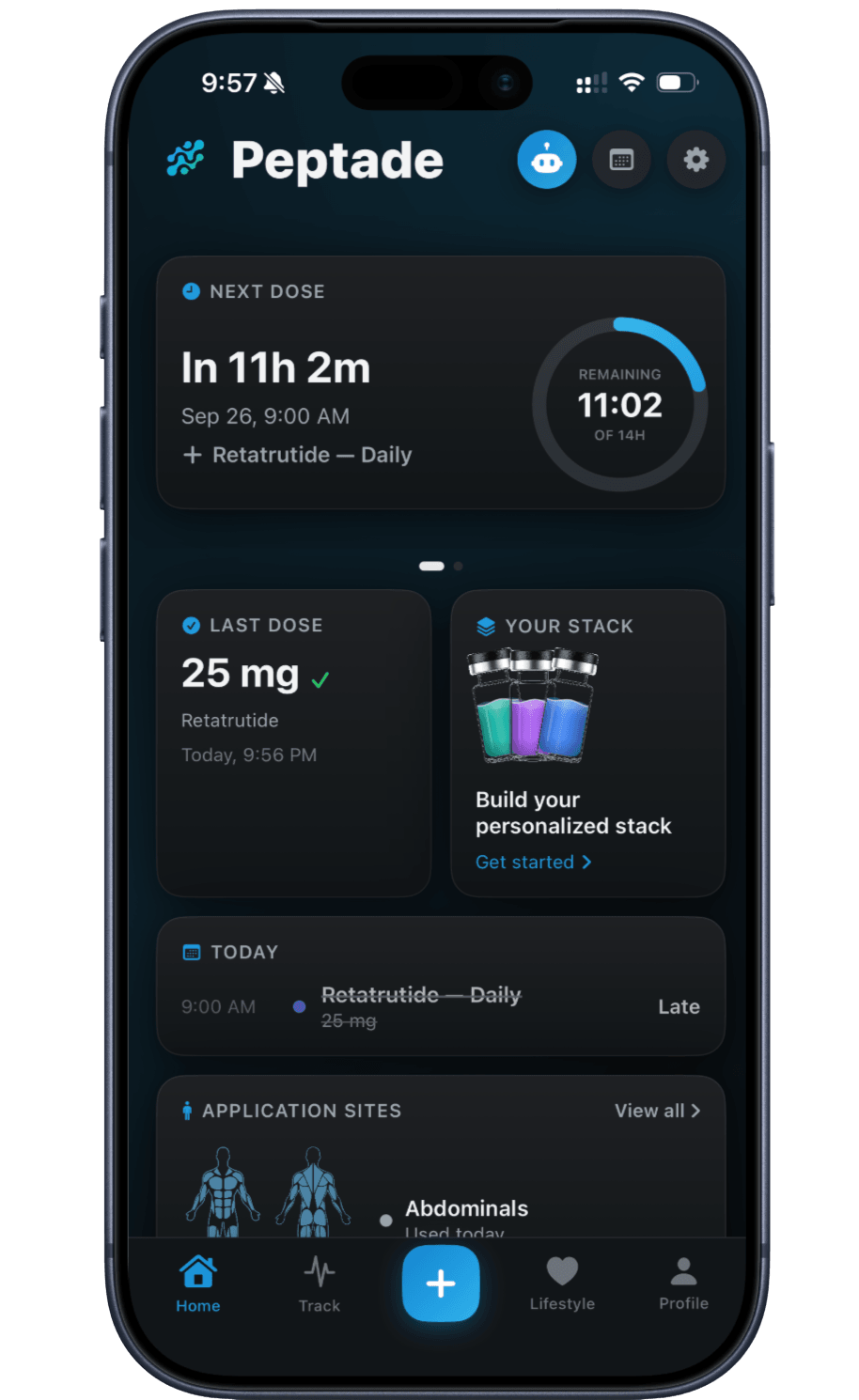
Medication Level draws a curve of a compound's estimated level on the Home screen, from the half-life you entered and the doses you've logged. Each logged dose is modeled as halving once per half-life, and the curve adds them together.
Nothing here comes from a catalog average. The half-life is a value you type in for that specific compound, so the curve reflects your own inputs, not a population estimate.
Because it's a model built on entered values and your own dose log, treat it as a visual estimate, not a measurement. It's most useful for seeing roughly where you sit between doses, not for making a decision about timing.
A curve built from your own numbers
Estimated level curve
A curve on Home built from your half-life value and logged doses.
Pick a time window
View the chart over 4, 8, 12 or 24 hours, centered on now.
Per-compound half-life
Set a half-life value for each compound individually — nothing is shared across compounds.
Reflects your logged doses
The curve changes when you log a dose; it doesn't project doses you haven't logged.
Read any point
Drag across the chart to read the estimated value and time; past now, the line turns dotted.
A visual estimate only
The curve is a model built from values you enter — not a lab reading or a diagnosis.
Frequently asked questions
No. It's a visual estimate built from the half-life you enter and the doses you've logged — not a lab measurement or a diagnostic reading.
You type it in yourself: turn on half-life tracking in a compound's settings and enter the value. Nothing is filled in for you, and the curve is only as accurate as the number you use. Doses logged in mg, mcg or g are modelled; doses logged in mL aren't.
No. It's a general model applied to the numbers you entered — it doesn't factor in your metabolism, weight, or other individual traits.
No. Timing comes from your prescriber's instructions and the product's labeling. The curve is a rough visual estimate, and Peptade's reminders and logs are a convenience, not a safeguard.
Keep exploring
- Half-lifePeptide half-life calculatorEnter a half-life, a dosing interval and a number of doses to see an estimated curve over time — a textbook model, not a personalized prediction.
- Research libraryResearch Library: Peptide & GLP-1 ProfilesBrowse peptide and GLP-1 profiles with regulatory status, evidence labels, mechanism and what research has studied — no doses for unapproved compounds.
- PepBotPepBot: In-App Peptide Research AssistantPepBot, Peptade's in-app research assistant, knows your own tracking data and gives no dose, range or cycle for a compound that isn't FDA-approved.
Track it in Peptade.
Doses, schedules, cycles, injection sites and supply — one app, free to download on iOS and Android.
Peptade is for tracking and education only. It is not medical advice, a diagnosis, or a prescription, and it does not tell you to take, start, stop or buy anything. See the Medical Disclaimer.