Calculator
Reconstitution calculator
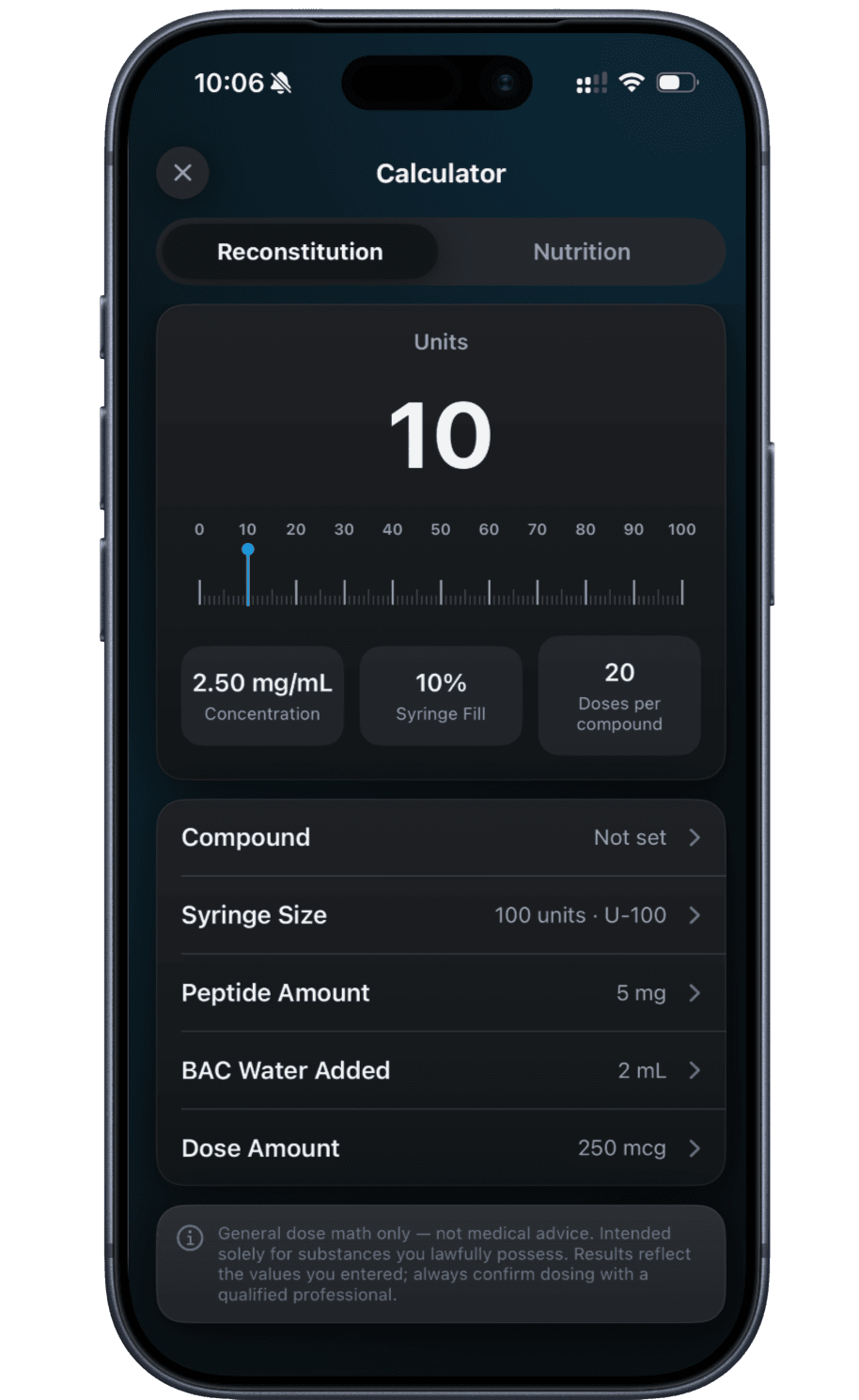
Type what's on your own vial and how much water you added. Get concentration, syringe units and doses per compound back — arithmetic on the numbers you enter, nothing looked up.
Reconstitution calculator
As stated on your own vial
The dose you have already decided on
Units (U-100 syringe)
—
Concentration
—
Syringe fill
—
Doses per compound
—
General dose math only — not medical advice. Intended solely for substances you lawfully possess. Results reflect the values you entered; always confirm dosing with a qualified professional.
Published by Peptade · Calculator · Updated September 2026
This is the same three-number conversion the app's calculator uses in Reconstitution mode. You type the total amount stated on your vial, the volume of bacteriostatic water you added, and the dose you've already decided on. It returns the concentration, how many syringe units that dose equals, what fraction of your syringe that fills, and how many such doses the vial holds.
There's no drug database behind it. It doesn't know what compound you're using, doesn't suggest a dose, and doesn't store a default for anything — it multiplies and divides the three numbers you typed, the same way for any liquid. A U-100 insulin syringe is marked in 100 units per milliliter, so every unit equals 0.01 mL; that's the scale the syringe-units result uses.
If you are considering using any injectable peptide, you must consult with a licensed physician or qualified healthcare provider before purchasing, reconstituting, or administering any injectable product. This applies regardless of whether a prescription is required in your jurisdiction. Injectable peptides carry additional risks including but not limited to infection, allergic reaction, nerve damage, and adverse events from improper reconstitution, contaminated supplies, incorrect technique, or dosing errors.
Never do this math twice.
Peptade keeps the numbers you enter for each compound, so its reconstitution tool fills them in for you next time — from your own entries, never from a catalog.
- Saved per compound
- Schedules, cycles and titrations
- Supply that counts down
How it works
Step 1
Enter your vial and water
Type the amount stated on your own vial and the bacteriostatic water you added. Concentration is one divided by the other — nothing is looked up.
Step 2
Enter your dose
Type the dose you've already decided on, in mg or mcg, and pick your syringe size. The calculator converts your dose into units on that syringe.
Step 3
Read the result
See the concentration, the syringe units, what fraction of the syringe that fills, and how many such doses the vial holds.
Worked example
- 6 mg vial ÷ 3 mL water = 2.00 mg/mL
- 0.3 mg (300 mcg) dose ÷ 2.00 mg/mL × 100 = 15 units
- 15 units ÷ 100-unit syringe = 15% full
- 6 mg vial ÷ 0.3 mg dose = 20 doses
Arithmetic on the numbers above, for a dose you've already chosen.
Arithmetic example only — not a suggested dose.
Frequently asked questions
No. It has no drug database and no compound-specific logic — it converts the vial amount, water and dose you type, the same arithmetic for any liquid.
No. It converts a dose you've already decided on — with your prescriber, where one is involved — into syringe units. It never proposes one of its own.
1 mL (100 units), 0.5 mL (50 units) and 0.3 mL (30 units) — the common U-100 insulin syringe sizes.
The calculator flags it instead of returning a number, so you can double-check what you typed rather than act on a bad result.
More free calculators
- CalculatorDose to syringe units converterTurn a dose you've already decided on into syringe units. Enter your vial, water and dose in mg or mcg — a plain unit converter, not a dosing guide.
- CalculatorBacteriostatic water calculatorWork out how much bacteriostatic water puts your chosen dose at a chosen syringe mark. Enter your vial, dose and target units — no defaults, no drug list.
- CalculatorInsulin syringe unit converterConvert between milliliters and units on a U-100 insulin syringe in either direction. A plain arithmetic converter — no vial, no compound, no drug data.
- CalculatorPeptide vial supply calculatorWork out how many doses a vial holds and how many days it will last, from the vial amount, your dose and how often you dose — arithmetic, not a protocol.
The calculators are general-purpose arithmetic on the values you enter, intended solely for substances you lawfully possess. Entering a value is not Peptade’s endorsement or verification of any substance or dose. See the Medical Disclaimer.