Health calculator
How much water should you drink a day?
Type your body weight. Peptade scales it by a common rule of thumb — milliliters of water per kilogram — to show a daily range in the units you prefer.
Water intake calculator
Daily water, all sources
—
An estimate from a standard published formula, for general self-tracking only — not medical or dietary advice. Your needs may differ; ask a qualified professional.
Published by Peptade · Health calculator · Updated September 2026
There's no single number that's right for every body on every day — heat, activity, sweat and ordinary variation all move the target. What follows is a widely used rule of thumb, not a measured requirement for you specifically.
The rule multiplies your body weight by a low and a high figure to give a daily range in milliliters, which the tool then converts to the units you prefer.
The rule this tool uses
This calculator multiplies your body weight in kilograms by 30 on the low end and 35 on the high end to show a daily range in milliliters. It's a common general-population rule of thumb repeated across fitness and clinical education material, rather than a figure set by a single dietary reference report.
For a point of comparison, the National Academies' Dietary Reference Intakes set an Adequate Intake for total water — from all beverages and food combined — of about 2.7 liters a day for women and about 3.7 liters a day for men. Those figures aren't per kilogram and won't match this calculator's output exactly; they're a population-level anchor, not a replacement for it.
Why the range moves for you
CDC notes that daily water needs vary by activity level, climate and other factors — you'll likely need more on a hot day, a heavier training day, or while unwell. Thirst, urine color and how you feel are more useful day-to-day signals than any single number a calculator gives you.
Track it, don't recalculate it.
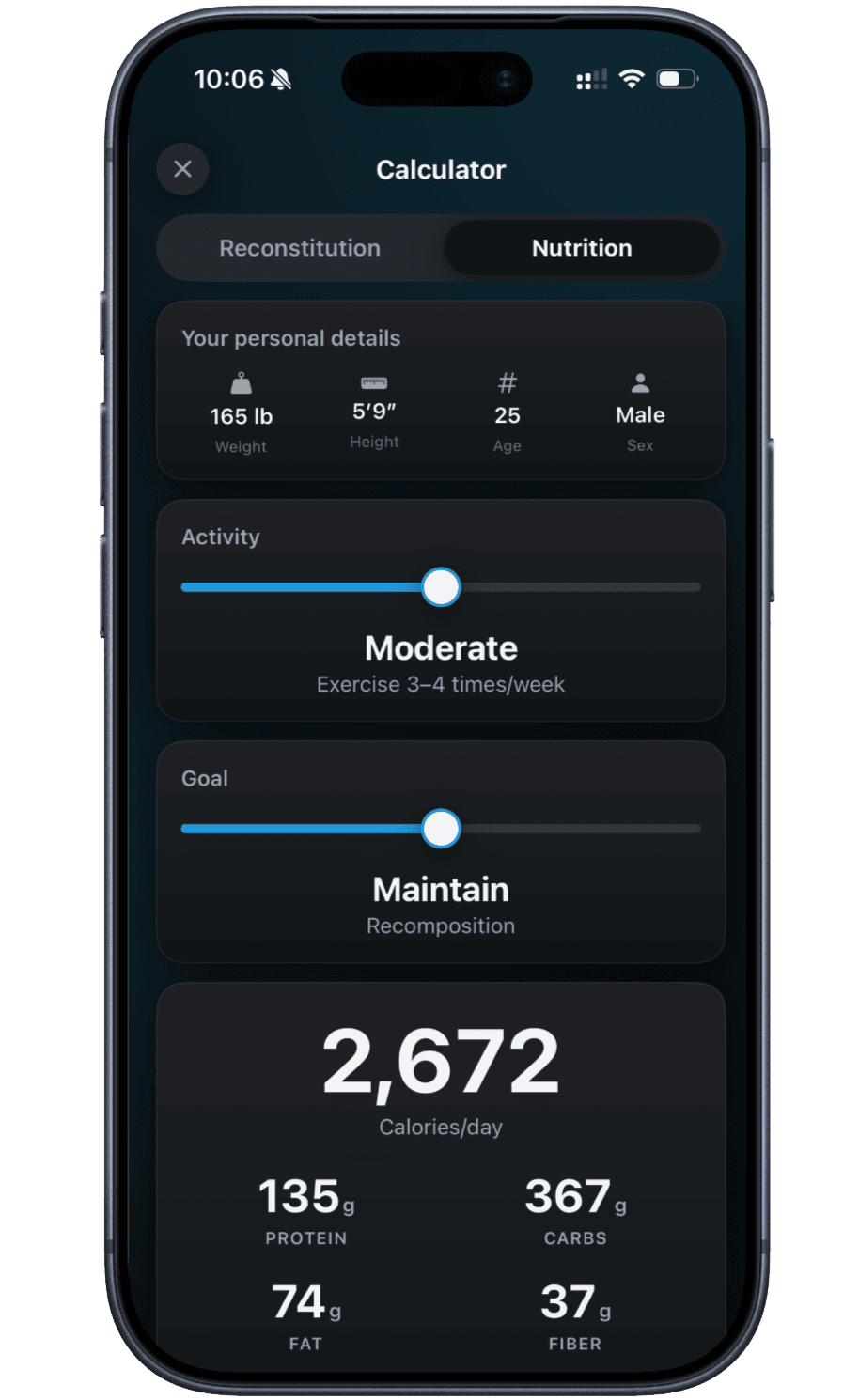
Peptade logs meals, water, weight, sleep and workouts next to your compounds, so the numbers build a trend on their own.
- Saved per compound
- Schedules, cycles and titrations
- Supply that counts down
Frequently asked questions
It's a commonly repeated general-population rule of thumb rather than a number from a single dietary reference report. We cite the National Academies' Adequate Intake figures alongside it for context, but that report doesn't use a per-kilogram formula.
The National Academies figures cited here count all beverages and the water in food, at roughly a four-to-one split. This calculator's range is a simpler total-fluid estimate and doesn't break out sources.
Likely yes. CDC lists higher activity, hot climates, fever, and vomiting or diarrhea among the situations that raise water needs above a typical day's range.
More free tools
- Health calculatorDaily calorie (TDEE) calculatorEstimate total daily energy expenditure from your age, weight, height and activity level using the Mifflin-St Jeor equation and CDC activity guidance.
- Hydration trackerHydration Tracker with Goals & RemindersLog water with quick-add buttons, see today's intake against a daily goal you can change, and set an optional daily reminder.
- Nutrition trackerNutrition Tracker: AI Food & Barcode ScanScan a meal, menu or barcode to estimate calories, protein and macros — or log any meal by hand. Values are approximate.
- Health calculatorBMI calculatorCalculate adult BMI from your height and weight and see where it falls in the CDC's four BMI categories, with CDC's own caveats about what BMI misses.
Nutrition, hydration, exercise and weight values are approximate and for general self-tracking only — not medical or dietary advice. If you have or suspect an eating disorder, a history of disordered eating, or any condition for which calorie or weight tracking could be harmful, consult a qualified healthcare professional before using these tools. See the Medical Disclaimer.