Health calculator
How many calories do you burn a day?
Type your age, weight, height and how active you are. Peptade runs the Mifflin-St Jeor equation and an activity multiplier to estimate your total daily energy expenditure — the calories it would take to hold your current weight steady.
TDEE calculator
Estimated daily energy (TDEE)
—
Resting energy (BMR)
—
Activity factor
1.375×
An estimate from a standard published formula, for general self-tracking only — not medical or dietary advice. Your needs may differ; ask a qualified professional.
Published by Peptade · Health calculator · Updated September 2026
Total daily energy expenditure (TDEE) is resting metabolism plus everything you move in a day, and it's the number most calorie targets for weight loss, maintenance or gain are built from. This tool estimates it from four inputs and a published formula, not a guess.
The estimate has two steps. First it works out your resting energy expenditure — the energy your body uses at complete rest — from your weight, height, age and sex. Then it multiplies that by a factor for how active you told it you are.
Step one: resting energy expenditure
The tool uses the Mifflin-St Jeor equation, a formula derived from indirect-calorimetry measurements in hundreds of adults and published in The American Journal of Clinical Nutrition in 1990. It combines your weight, height and age, with a fixed offset for sex, into a single resting-energy number in calories a day.
Step two: the activity multiplier
Resting energy alone undercounts what an active day costs, so the tool scales that resting number by a multiplier you choose. The tool offers five levels: Sedentary (little or no exercise) at 1.2, Light (1 to 3 days a week) at 1.375, Moderate (3 to 5 days a week) at 1.55, Active (6 to 7 days a week) at 1.725, and Very active (hard training or a physical job) at 1.9. Pick the level that matches most weeks, not your best week.
CDC's physical activity guidelines frame a moderately active week as around 150 minutes of moderate aerobic activity plus muscle-strengthening work on two or more days — a useful anchor if you're not sure which multiplier fits.
Track it, don't recalculate it.
Peptade logs meals, water, weight, sleep and workouts next to your compounds, so the numbers build a trend on their own.
- Saved per compound
- Schedules, cycles and titrations
- Supply that counts down
Frequently asked questions
No. TDEE estimates what keeps your weight roughly steady. Eating above it tends to add weight over time and eating below it tends to remove it, but this tool doesn't set a target for you — it only estimates the maintenance number.
Because it's a multiplier on your resting energy, not a fixed add-on. Moving from sedentary to very active roughly multiplies your resting number by up to about 1.6 times as much, which is why picking an honest average week matters more than picking an aspirational one.
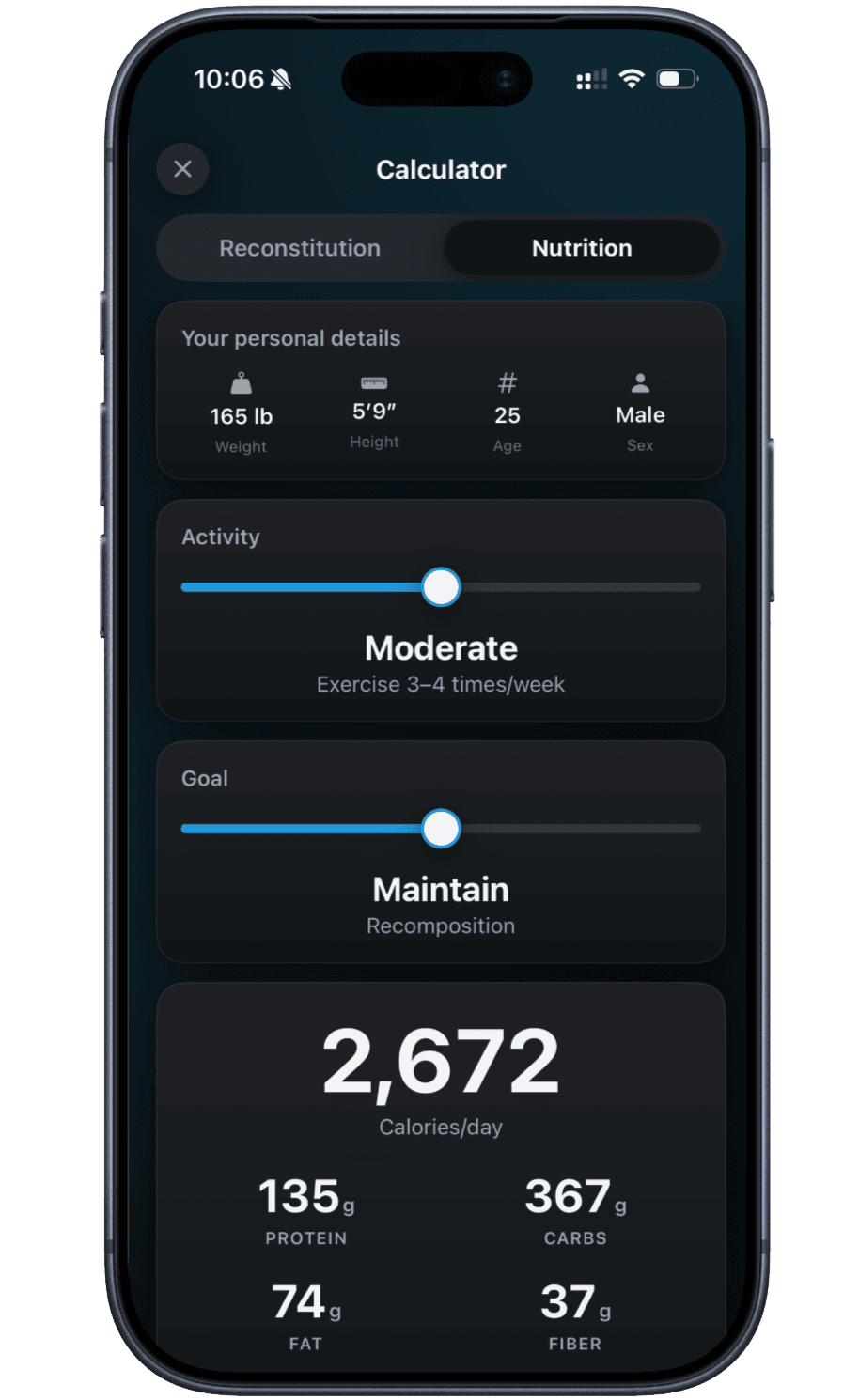
The app's Nutrition Calculator uses the same Mifflin-St Jeor equation on the weight, height, age and sex in your profile, then applies a goal you pick to give daily calorie, protein, carb, fat and fiber targets that you can save as your nutrition goals.
The Mifflin-St Jeor equation is one of the most widely used resting-energy formulas in nutrition research, but like any formula built from population averages, it's a general estimate rather than an exact figure for any one body. Actual expenditure varies with muscle mass, genetics and other factors the formula doesn't see.
More free tools
- Health calculatorDaily protein calculatorType your body weight and pick a general or active range to see a daily protein target in grams, backed by published nutrition research.
- Health calculatorWater intake calculatorTurn your body weight into a daily water range using a common milliliters-per-kilogram rule of thumb, with National Academies figures for context.
- Half-lifePeptide half-life calculatorEnter a half-life, a dosing interval and a number of doses to see an estimated curve over time — a textbook model, not a personalized prediction.
- Nutrition trackerNutrition Tracker: AI Food & Barcode ScanScan a meal, menu or barcode to estimate calories, protein and macros — or log any meal by hand. Values are approximate.
- Weight trackerWeight Tracker with a Progress ChartLog a daily weigh-in in kg or lb, chart it over the range you pick, and see how far you are from a goal weight you set.
Nutrition, hydration, exercise and weight values are approximate and for general self-tracking only — not medical or dietary advice. If you have or suspect an eating disorder, a history of disordered eating, or any condition for which calorie or weight tracking could be harmful, consult a qualified healthcare professional before using these tools. See the Medical Disclaimer.