Health calculator
Daily protein calculator
Type your body weight and pick a range that matches your situation. Peptade turns it into a daily protein target in grams — no account, no catalog, just arithmetic on the number you typed.
Protein calculator
Daily protein
—
Per kg of body weight
0.8g/kg
An estimate from a standard published formula, for general self-tracking only — not medical or dietary advice. Your needs may differ; ask a qualified professional.
Published by Peptade · Health calculator · Updated September 2026
Protein needs scale with body weight, not a single number that fits everyone. This calculator multiplies the weight you enter by a low and a high gram-per-kilogram figure to show a daily range, the same way a dietitian would sketch one on paper.
Pick the range that matches your situation: a general baseline for healthy adults, or a higher range used for adults who train and want to build or maintain muscle. Switch weight units at any time — the math updates as you type.
The two ranges, and where they come from
The general range uses 0.8 g of protein per kilogram of body weight — the Recommended Dietary Allowance the Institute of Medicine set for healthy adults, a figure that has barely moved in decades.
The active range uses 1.4 to 2.0 g per kilogram, the range the International Society of Sports Nutrition's position stand gives for adults training to build or maintain muscle. It's higher because building or preserving muscle costs more protein than simply avoiding a deficiency.
What the calculator does with your number
It multiplies your body weight in kilograms by the low and high ends of the range you picked. That's the whole calculation — there's no adjustment for age, sex or body composition, because the published ranges are already given per kilogram of total body weight.
Track it, don't recalculate it.
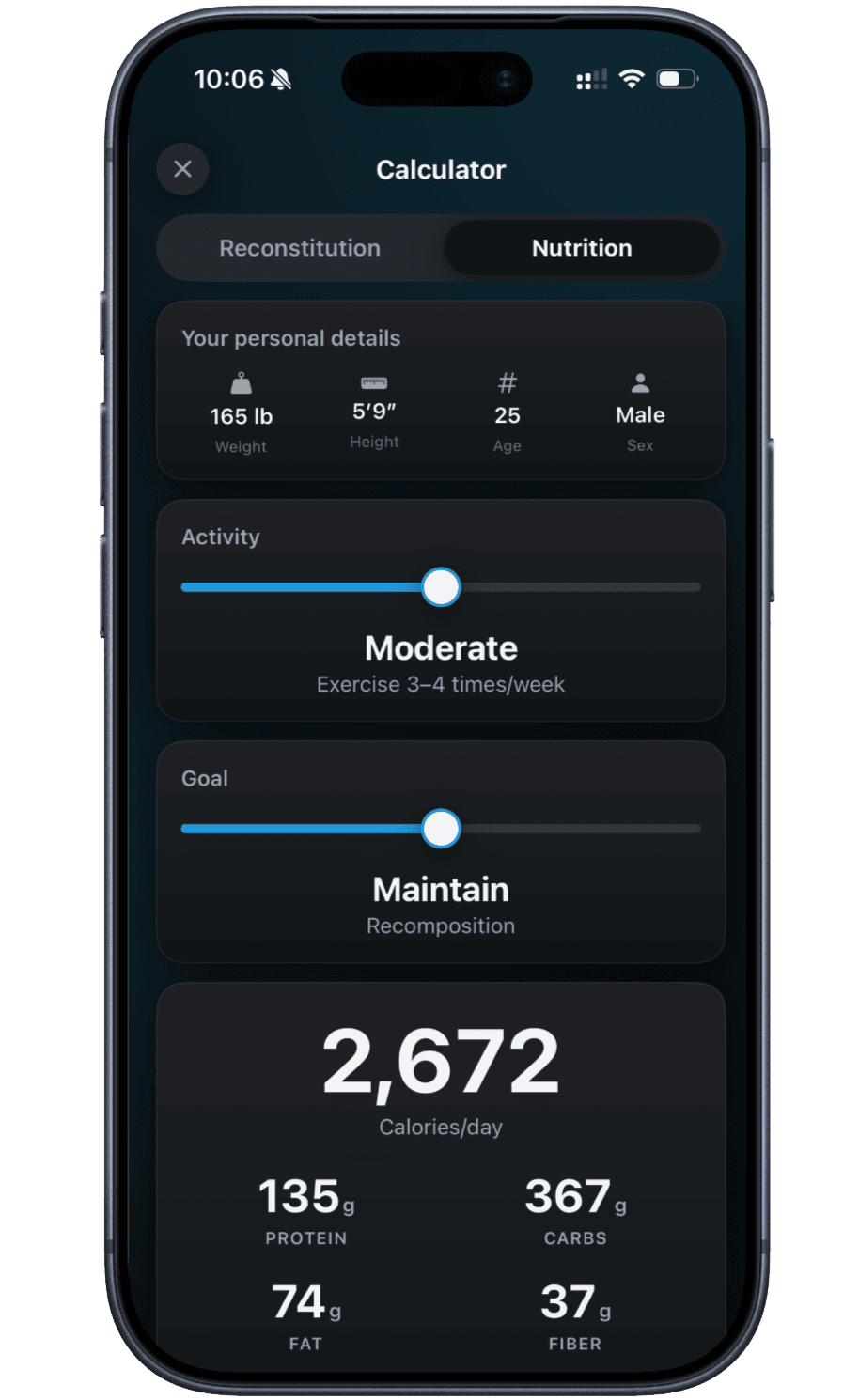
Peptade logs meals, water, weight, sleep and workouts next to your compounds, so the numbers build a trend on their own.
- Saved per compound
- Schedules, cycles and titrations
- Supply that counts down
Frequently asked questions
No. It's arithmetic on two published, general-population ranges. Your own needs can differ with age, kidney function, pregnancy or a medical condition, so treat the result as a starting point for a conversation with a dietitian or your prescriber, not a personal number.
The general range is a baseline meant to cover nearly every healthy adult. The active range comes from sports-nutrition research on adults who train and are trying to build or hold onto muscle, which takes more protein than the baseline.
No. Both published ranges are given per kilogram of body weight only, so that's the only number this tool asks for besides which range you want.
More free tools
- Health calculatorGLP-1 protein calculatorA protein calculator with a range for active weight reduction on GLP-1 medicines, cited to a 2025 joint advisory from four U.S. medical societies.
- Health calculatorDaily calorie (TDEE) calculatorEstimate total daily energy expenditure from your age, weight, height and activity level using the Mifflin-St Jeor equation and CDC activity guidance.
- Health calculatorFiber intake calculatorTurn your daily calories into a fiber target using the 14-gram-per-1,000-calorie Adequate Intake that most U.S. adults currently fall short of.
- Nutrition trackerNutrition Tracker: AI Food & Barcode ScanScan a meal, menu or barcode to estimate calories, protein and macros — or log any meal by hand. Values are approximate.
- Workout trackerWorkout Tracker with a Muscle Recovery MapLog sets, reps and weight, see which muscles you've worked on a color-coded recovery map, and chart your heaviest set per exercise.
Nutrition, hydration, exercise and weight values are approximate and for general self-tracking only — not medical or dietary advice. If you have or suspect an eating disorder, a history of disordered eating, or any condition for which calorie or weight tracking could be harmful, consult a qualified healthcare professional before using these tools. See the Medical Disclaimer.