Health calculator
Goal weight timeline calculator
Type your current weight, your goal weight and a steady weekly rate. Peptade divides the distance between the two by that rate to show roughly how many weeks the pace would take.
Goal weight timeline
Weeks to goal at that pace
—
Around
—
An estimate from a standard published formula, for general self-tracking only — not medical or dietary advice. Your needs may differ; ask a qualified professional.
Published by Peptade · Health calculator · Updated September 2026
This is a single division: the weight you have left to lose, divided by how much you're losing per week. It assumes the rate you enter holds steady, which real progress rarely does in a straight line — plateaus and faster early results are both normal.
Treat the result as a rough planning number, not a countdown you're meant to hit exactly.
The formula
Weeks to goal equals your current weight minus your goal weight, divided by your weekly loss rate. Enter a goal above your current weight and the tool won't return a timeline, since the formula only works in one direction.
Choosing a weekly rate to type in
CDC describes a gradual, steady pace — about one to two pounds a week — as more sustainable than losing weight quickly, on the basis that people who lose weight gradually are more likely to keep it off. It's a description of a pace, not a target this tool sets — a clinician or registered dietitian can help you choose a rate that suits you.
Track it, don't recalculate it.
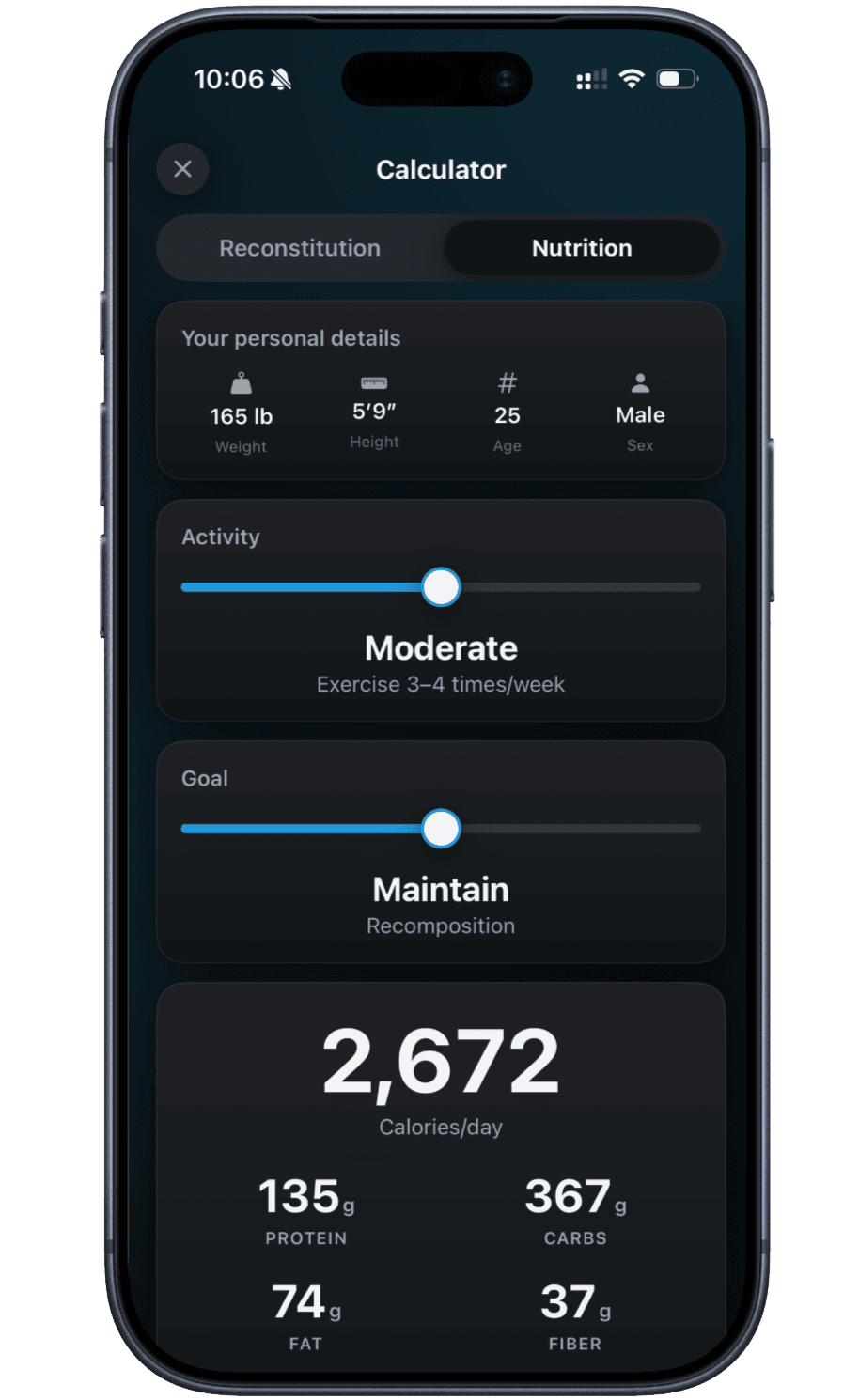
Peptade logs meals, water, weight, sleep and workouts next to your compounds, so the numbers build a trend on their own.
- Saved per compound
- Schedules, cycles and titrations
- Supply that counts down
Frequently asked questions
Most likely your goal weight is at or above your current weight — the formula only projects forward when there's a gap to close and a positive weekly rate to close it with.
No. It assumes the exact rate you type holds every single week, which is a simplification — plateaus, faster early results and ordinary week-to-week swings are all normal, and this tool doesn't model any of them.
CDC frames about one to two pounds a week as a gradual, sustainable pace for most adults. Entering a much faster rate will shorten the estimate, but won't make that pace realistic.
More free tools
- Health calculatorWeight loss percentage calculatorCalculate the percentage of body weight you've lost between two weigh-ins — the measure researchers use instead of raw pounds or kilograms.
- Health calculatorDaily calorie (TDEE) calculatorEstimate total daily energy expenditure from your age, weight, height and activity level using the Mifflin-St Jeor equation and CDC activity guidance.
- Weight trackerWeight Tracker with a Progress ChartLog a daily weigh-in in kg or lb, chart it over the range you pick, and see how far you are from a goal weight you set.
- Health calculatorBMI calculatorCalculate adult BMI from your height and weight and see where it falls in the CDC's four BMI categories, with CDC's own caveats about what BMI misses.
Nutrition, hydration, exercise and weight values are approximate and for general self-tracking only — not medical or dietary advice. If you have or suspect an eating disorder, a history of disordered eating, or any condition for which calorie or weight tracking could be harmful, consult a qualified healthcare professional before using these tools. See the Medical Disclaimer.