Health calculator
How much fiber should you eat a day?
Type your daily calorie target. Peptade scales it by the Adequate Intake ratio for fiber — grams per 1,000 calories — to show a daily gram target.
Fiber intake calculator
Daily fiber target
—
An estimate from a standard published formula, for general self-tracking only — not medical or dietary advice. Your needs may differ; ask a qualified professional.
Published by Peptade · Health calculator · Updated September 2026
Fiber recommendations are usually written as a ratio to calories, not a flat number, because someone eating more food has more opportunity to also eat more fiber. This calculator applies that ratio to the calorie number you type, whether that came from the TDEE calculator or somewhere else.
It's arithmetic on one input. If your calorie estimate is off, the fiber target will be too — that's the nature of a ratio-based figure.
The ratio this tool uses
Fiber's Adequate Intake is set at 14 g per 1,000 kilocalories consumed. This calculator multiplies your daily calories by that ratio to produce a gram target — 2,000 calories works out to 28 g, for example.
USDA's own analysis of national food-consumption data uses that same 14-gram figure as the benchmark it measures Americans' actual fiber intake against.
Why fiber gets its own number
The Institute of Medicine set this Adequate Intake from research linking fiber intake to heart-disease risk, among other outcomes. USDA data shows most Americans eat well under the target on average, which is part of why it's worth a specific number instead of a vague instruction to eat more vegetables.
Track it, don't recalculate it.
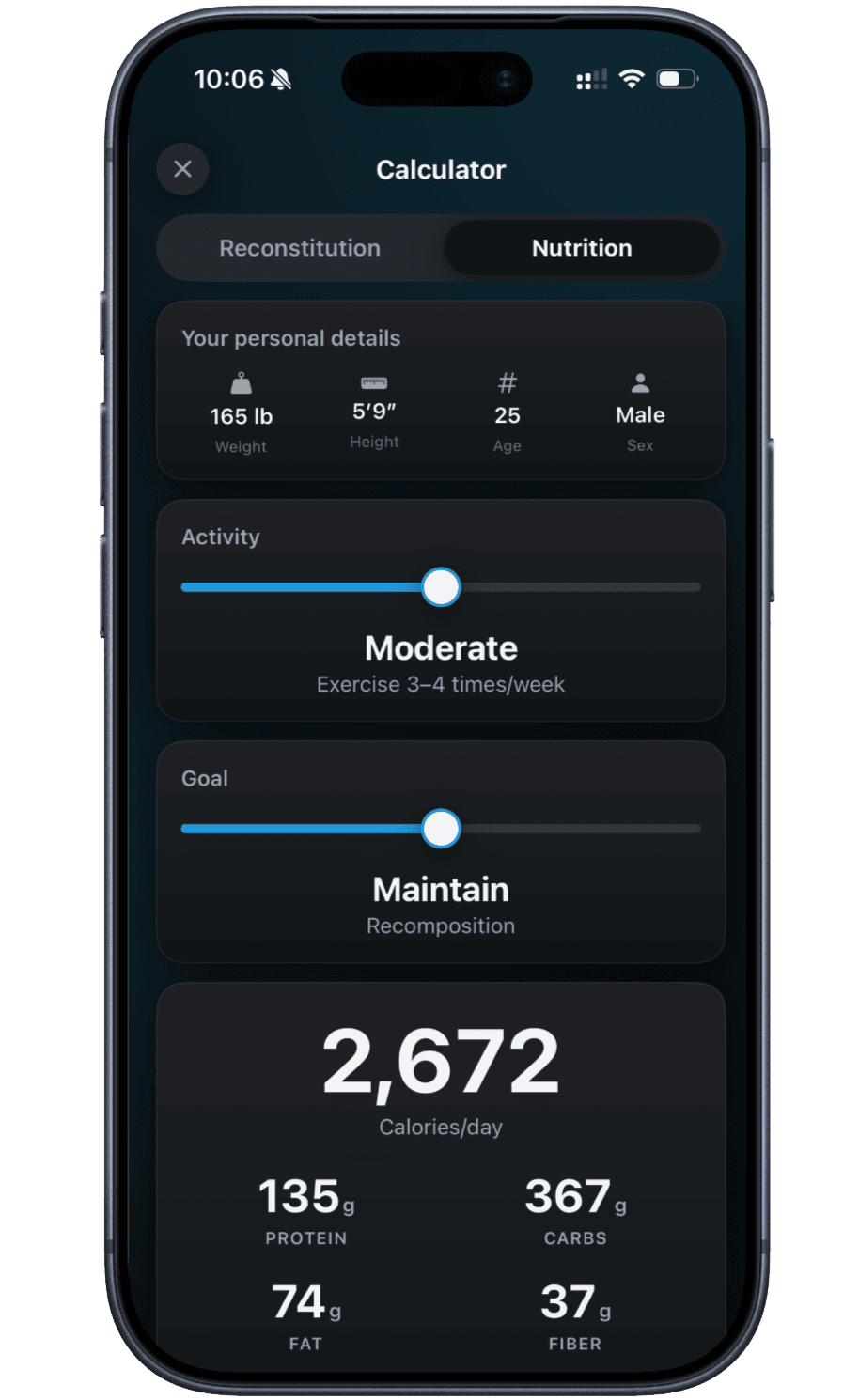
Peptade logs meals, water, weight, sleep and workouts next to your compounds, so the numbers build a trend on their own.
- Saved per compound
- Schedules, cycles and titrations
- Supply that counts down
Frequently asked questions
Because food volume and fiber intake move together — someone eating more food has more room to also eat more fiber. Tying the target to calories keeps the ratio meaningful across very different appetites.
Use the TDEE calculator on this site to estimate a daily calorie number first, then bring that number here.
This tool doesn't set an upper limit — it only reports the Adequate Intake ratio. A large, sudden increase in fiber can cause digestive discomfort for some people, so raising your intake gradually and with enough water is the more common practical approach.
More free tools
- Health calculatorDaily calorie (TDEE) calculatorEstimate total daily energy expenditure from your age, weight, height and activity level using the Mifflin-St Jeor equation and CDC activity guidance.
- Health calculatorDaily protein calculatorType your body weight and pick a general or active range to see a daily protein target in grams, backed by published nutrition research.
- Nutrition trackerNutrition Tracker: AI Food & Barcode ScanScan a meal, menu or barcode to estimate calories, protein and macros — or log any meal by hand. Values are approximate.
- Health calculatorWater intake calculatorTurn your body weight into a daily water range using a common milliliters-per-kilogram rule of thumb, with National Academies figures for context.
Nutrition, hydration, exercise and weight values are approximate and for general self-tracking only — not medical or dietary advice. If you have or suspect an eating disorder, a history of disordered eating, or any condition for which calorie or weight tracking could be harmful, consult a qualified healthcare professional before using these tools. See the Medical Disclaimer.