Health calculator
Body fat calculator (U.S. Navy method)
Type your height, neck and waist — and, if you're estimating for a woman, hip — measurements. Peptade runs the U.S. Navy circumference formula to estimate body fat percentage from a tape measure alone.
Body fat calculator (U.S. Navy method)
Just below the larynx
At the narrowest point
At the widest point
Estimated body fat
—
An estimate from a standard published formula, for general self-tracking only — not medical or dietary advice. Your needs may differ; ask a qualified professional.
Published by Peptade · Health calculator · Updated September 2026
The U.S. Navy method estimates body fat percentage from a handful of circumference measurements instead of calipers, a scan or a water tank. The armed forces adopted circumference-based formulas in the 1970s and 1980s because they needed something a unit could measure in the field.
It won't match a DEXA scan exactly for any one person, but it's a reasonable, repeatable estimate you can redo yourself with a tape measure and track over time.
What it measures
For men, the formula uses neck and waist (abdomen) circumference alongside height. For women, it adds a hip measurement, because fat distribution differs enough between men and women that the men's formula alone doesn't hold up as well.
The Navy's James Hodgdon developed the current equations against a sample of male and female sailors and validated them against a separate sample of soldiers, building on circumference formulas the Marine Corps had adopted earlier.
How accurate it is
A 2022 study validating the method against DEXA scanning in U.S. Marines found it underestimated men's body fat by about 2.5 to 2.6 percentage points on average and overestimated women's by about 1.3 to 2.3 percentage points, with several points of scatter around each estimate. Treat the result as a reasonable estimate with a real margin of error, not an exact figure.
Track it, don't recalculate it.
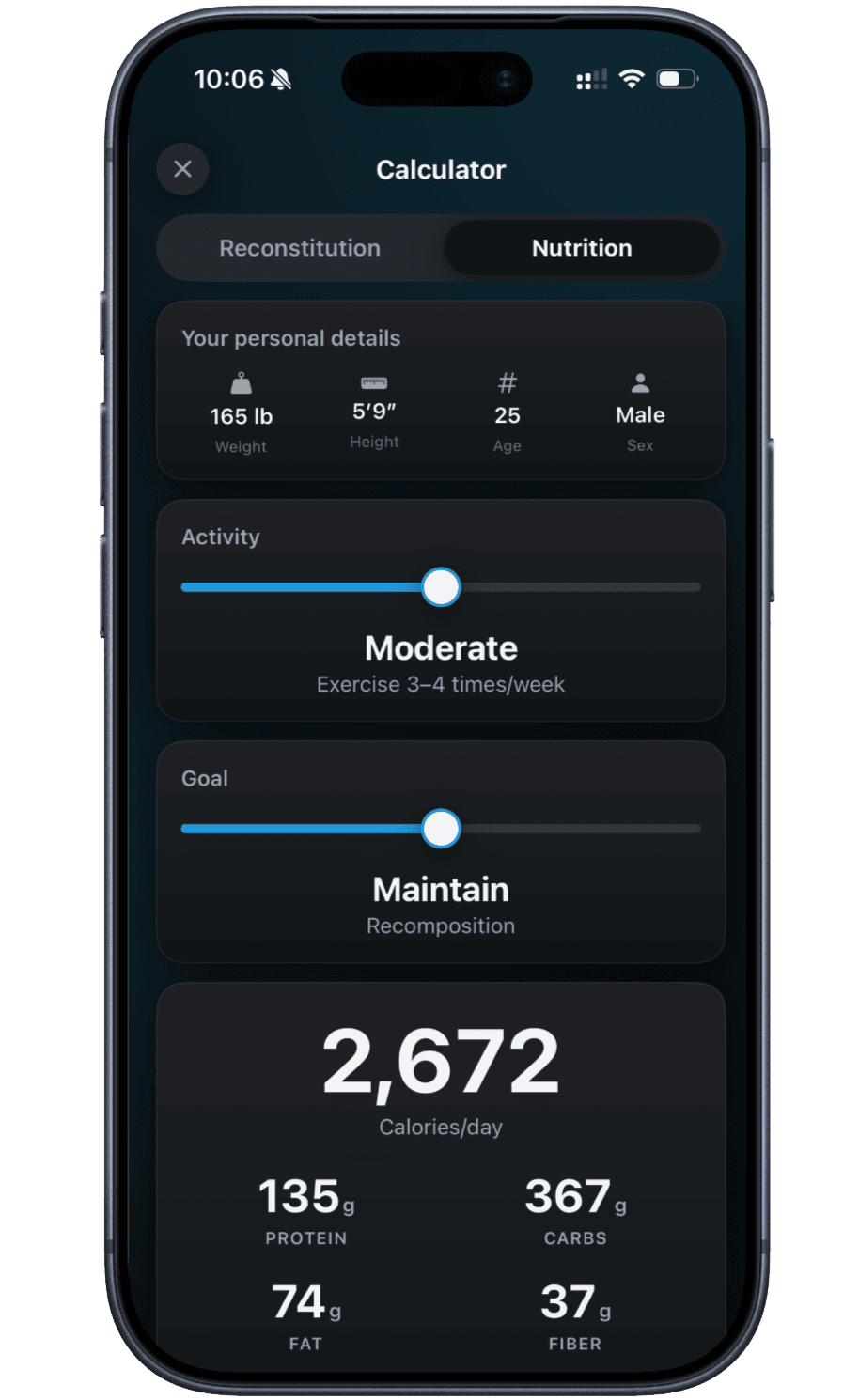
Peptade logs meals, water, weight, sleep and workouts next to your compounds, so the numbers build a trend on their own.
- Saved per compound
- Schedules, cycles and titrations
- Supply that counts down
Frequently asked questions
Because typical fat distribution differs by sex, and the validation studies found the men's neck-and-waist formula alone didn't predict women's body fat as well. Adding hip circumference corrects for that.
A study validating the method against DEXA scanning found it runs a few percentage points off on average — underestimating in men and overestimating in women — with meaningful scatter from person to person. It's a field estimate, not a lab measurement.
The tool measures men at the navel and women at the narrowest point of the abdomen. Measure at the same spot every time so your own numbers stay comparable to each other, even if they read differently from a lab method in absolute terms.
More free tools
- Health calculatorBMI calculatorCalculate adult BMI from your height and weight and see where it falls in the CDC's four BMI categories, with CDC's own caveats about what BMI misses.
- Health calculatorWeight loss percentage calculatorCalculate the percentage of body weight you've lost between two weigh-ins — the measure researchers use instead of raw pounds or kilograms.
- Weight trackerWeight Tracker with a Progress ChartLog a daily weigh-in in kg or lb, chart it over the range you pick, and see how far you are from a goal weight you set.
- Workout trackerWorkout Tracker with a Muscle Recovery MapLog sets, reps and weight, see which muscles you've worked on a color-coded recovery map, and chart your heaviest set per exercise.
Nutrition, hydration, exercise and weight values are approximate and for general self-tracking only — not medical or dietary advice. If you have or suspect an eating disorder, a history of disordered eating, or any condition for which calorie or weight tracking could be harmful, consult a qualified healthcare professional before using these tools. See the Medical Disclaimer.